
Give your AI agent a brain that remembers.

Never lose context again. Kiomon saves your work automatically and brings it back when you need it.

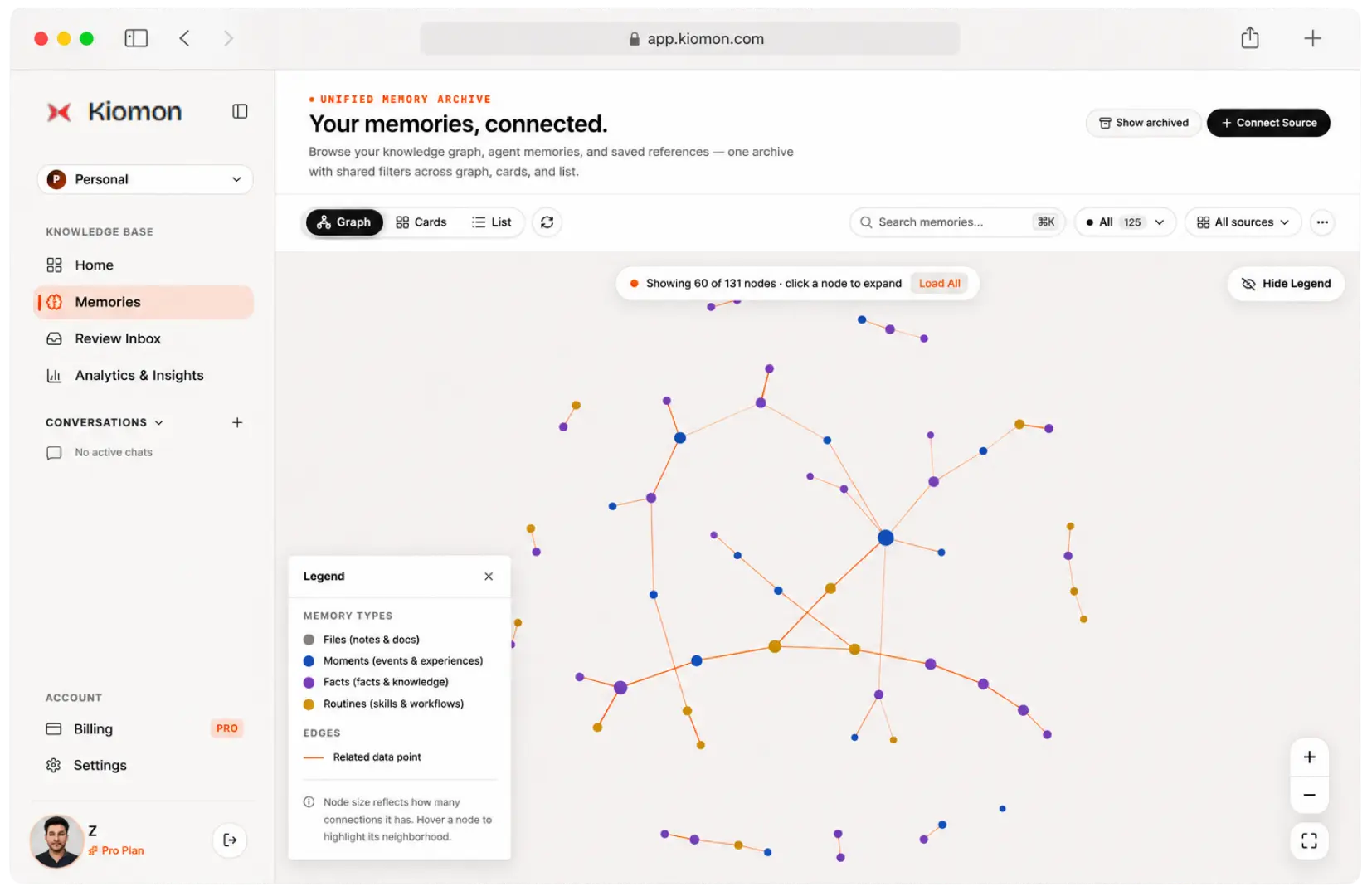
Kiomon live knowledge graph dashboard view showing interconnected memory nodes
⚡
search_memory semantic · 94% relevance
✓
Review Inbox 3 memories approved

Native MCP clients & sources it connects

Cursor Claude OpenAI Ollama Gemini Codex Notion Confluence Google Drive Slack Cursor Claude OpenAI Ollama Gemini Codex Notion Confluence Google Drive Slack


Your agent starts every session with amnesia.

Every time you close a session, your AI forgets everything. You are forced to re-explain your rules, code structure, and decisions from scratch.

01 Volatile State Boundaries

Context evaporates on process teardown.

LLM API calls are stateless functions over ephemeral token windows. When an IDE session closes or an agent process exits, every architectural decision and convention vanishes from RAM.

02 Token Budget Saturation

Cold file scans degrade reasoning precision.

Re-ingesting 30+ raw source files on every turn burns thousands of tokens. Kiomon uses surgical graph traversal to load only what is relevant via get_workspace_context.

03 The Re-Prompting Overhead

Stop acting as a human state router.

Developers waste ~4.5 hours every week re-pasting guidelines, rules, and schemas into new chats. Kiomon keeps your rules pinned and auto-injected.

04 Universal Agent Rail

Native MCP across your entire toolchain.

Connects seamlessly to Claude, Cursor, Ollama, Notion, Confluence, and custom agent scripts with zero custom glue code.

Claude Claude
Cursor Cursor
Ollama Ollama
Notion Notion
Confluence Confluence
Google Drive Google Drive
Open MCP Standard · Zero Lock-In
0% Stateless LLMs

Cross-session context retention in standard LLM client sessions

~4.5 hrs Saved / Dev / Wk

Engineering overhead lost to manual prompt & rule re-pasting

97.4% Token Efficiency

Token overhead eliminated via indexed hybrid graph retrieval

From raw context to a brain that remembers.

Scroll down to explore each stage of the pipeline.

01 Capture

Everything your agent needs, saved instantly.

Save tabs, notes, and documents from the browser extension, forward context via inbound email, or sync Notion, Confluence, and Google Drive on a schedule. Your agent drafts what it learned on its own. Every capture lands in your workspace, one second after it happens.

Browser extensionEmail InboundSave URLNotionConfluenceGoogle Drivedraft_memory
1s capture → memory
02 Clean

Noise is stripped before it ever touches a token.

Kiomon automatically strips away ads, navigation, and junk markup. It uses Gemini in the background to extract the exact facts and entities you care about, giving your agent clean, high-signal context.

Extract entitiesExtract claimsDetect domainDeduplicateSuggest kind
94% less noise, fewer tokens
03 Connect

Native MCP & Agent SDK. Any agent, any client.

Connect Kiomon directly to Claude Code, Cursor, Gemini CLI, or any MCP-compatible app. Or use our native TypeScript SDK (@kiomon/kiomon) to power custom agent swarms with zero glue code and zero vendor lock-in.

Claude CodeCursor IDEGemini CLICodex CLINative Agent SDKREST API
Native MCP protocol & SDK
04 Remember

Memories that strengthen with use, decay with disuse.

Kiomon organizes your knowledge into moments, facts, routines, and sources. Every memory connects to a live knowledge graph that powers sub-150ms recall, guards your review inbox, and autonomously synthesizes weekly intelligence briefings.

MomentsFactsRoutinesSourcesWeekly briefingsKnowledge graph
4 memory kinds, linked

Agents forget between sessions. This doesn't.

Pull relevant context before your agent acts, save what it learns as it works, and trace how ideas connect using open MCP standards.

agent-session · michelle/coding-agent MCP LIVE

› get_workspace_context(topic: "vector-search")

· pinned · "BM25 fuses keyword + vector via RRF"

· routines · 3 runbooks · strength 0.72+

· moments · last retrieval 2h ago

› retrieve_memory({intent: "execute", query: "deploy vector service"})

ContextPacket · 3 facts · 1 procedure applicability 0.91 · warnings 0 · evidence 2

› draft_memory({… confidence: 0.9}) ✓ auto-activated

› record_outcome({outcome: "success"}) ▍

Review inbox
3 drafts
Proposal: MCP v1.0 schema landed Claude · draft_memory
approve
Deploy runbook for vector service Cursor · reflect_session
approve
Decided: drop legacy scraper layer Coding agent · draft_memory
approve

Confident saves auto-activate; the rest wait here for your review. Every change is visible and reversible.

01 READ & ORIENT Intent-aware

Pre-flight context loading and intent-aware retrieval — `retrieve_memory` hands your agent the facts, procedure, and warnings it needs to act, not just search hits.

get_workspace_contextretrieve_memorysearch_memory
02 REFLECT & SAVE Write gate

The agent records decisions and runbooks to your brain. A write gate auto-activates confident saves and routes the rest to your Review Inbox — every change is reversible.

draft_memoryreflect_session
03 WALK & LEARN Outcomes

Report how the memories you used performed with `record_outcome`, walk evidence trails, and revert any autonomous change — the brain gets better with every outcome.

record_outcomeexplore_memory_graphmanage_memory

All 14 tools over native MCP.

Every call streams over standard MCP with zero custom glue code and no vendor lock-in.

list_workspacesselect_workspaceget_workspace_contextsearch_memoryget_memoryretrieve_memoryexplore_memory_graphget_latest_briefingdraft_memoryreflect_sessionmanage_memoryrecord_outcomesave_documentlist_memories
NATIVE AGENT SDK

Building custom agent swarms?

Wire persistent memory directly into your TypeScript & Node runtimes with the official Kiomon SDK. Call all 12 memory-native verbs with strict typing, automatic retries, and cryptographic state safety.

$ npm i @kiomon/kiomon
SDK Quickstart

Built like a vault, behaves like a brain.

01

Encrypted at rest & in transit

AES-256 at rest, TLS 1.3 in transit. Keys managed through your own infrastructure.

02

Zero-trust by design

Per-user workspace isolation with scoped API keys. Your memory is yours alone.

03

No training on your data

Never used to train models. Ever. Your context stays confidential.

04

You stay in control

One-click data control. Preview, approve, pin, archive, or delete your data anytime.

Free for you. Pro for your work. Enterprise for your team.

No credit card required for the free plan. Simple monthly billing with the freedom to cancel anytime.

Free

$0 forever

For solo builders giving their first agent a brain.

  • Up to 3,000 memories
  • Standard hybrid search
  • Browser extension + all MCP tools
  • 14-day Pro trial on signup
  • No credit card required
Start free
Popular

Pro

$19 /mo

For professionals and builders who want full, permanent memory for their agents.

  • Up to 150,000 memories
  • 5 team members included (+$5 per extra seat)
  • Connectors: Notion · Confluence · Drive
  • Auto-link knowledge graph
  • Priority vector search & AI extraction
  • Review inbox & workspace graph
  • Support from the team
Upgrade

Enterprise

Custom for teams

For organizations running the agent brain at scale across teams and clients.

  • Per-client isolated workspaces
  • Team SSO / SAML & provisioning
  • Dedicated storage & data retention policies
  • High-throughput MCP concurrency
  • Dedicated support & SLA
  • Custom onboarding & implementation
Contact sales

Prices in USD. Billing handled securely by Dodo Payments. Need more scale? Talk to us.

Questions, answered.

Something else on your mind? Email us and we will reply quickly.

What exactly is Kiomon?

Kiomon gives AI agents persistent memory. It captures what your agents need (like browser tabs, documents, and code decisions), turns them into clean memories, and feeds them back to any MCP-enabled agent on demand.

Which agents and tools work with Kiomon?

Any client that speaks the Model Context Protocol (MCP), including Claude Desktop, Claude Code, Cursor, Gemini CLI, and Codex CLI. For custom swarms, pipelines, or web applications, you can use our official TypeScript Agent SDK (@kiomon/kiomon) or REST API.

How do I capture context and documents into Kiomon?

Capture web pages, articles, and notes with our browser extension, forward emails directly to your workspace inbound address, or sync Notion, Google Drive, and Confluence. Connected agents and workflows can also draft memories automatically using the MCP tools (`draft_memory`, `reflect_session`) or our native SDK.

What are Weekly Intelligence Briefings?

Kiomon continuously analyzes your workspace activity over trailing 7-day windows to synthesize executive intelligence briefings. Each edition tracks key topics, connected ideas, revisited insights, and pending action items in a dedicated reading room, and can be retrieved directly by agents via the `get_latest_briefing` MCP tool.

How is this different from RAG or a vector database?

Traditional RAG simply retrieves document chunks at query time and starts fresh every session. Kiomon creates an evolving knowledge graph of events, facts, runbooks, and references that your agent can read and update directly. It functions as durable memory infrastructure rather than a basic search index.

Is my data used for training?

No. Your captures and memories are never used to train models. They are encrypted at rest and scoped to your workspace with per-user keys.

How do I keep my agent from writing junk into memory?

A write gate keeps junk out. When your agent proposes a memory, it sets a confidence score. High-confidence saves auto-activate so your agent isn’t blocked; anything less confident lands in your Review Inbox as a draft you approve or reject. Every autonomous change is visible in the “Kiomon’s decisions” feed and reversible with one click.

What happens to unused memories?

Memories are scored by strength and decay over time based on use. Retrieval makes a memory stronger; neglect lets it fade. Pinned memories are exempt from decay and always rank first.

A brain for every agent you ship.

Free for your first 3,000 memories. No credit card required. Give your agents the memory they need to actually do the job.

AES-256 encrypted at rest · No training on your data · Delete anytime